

 Back to All Newsletters
Cows, Robots and Manufacturing: AI This Week


Welcome Back
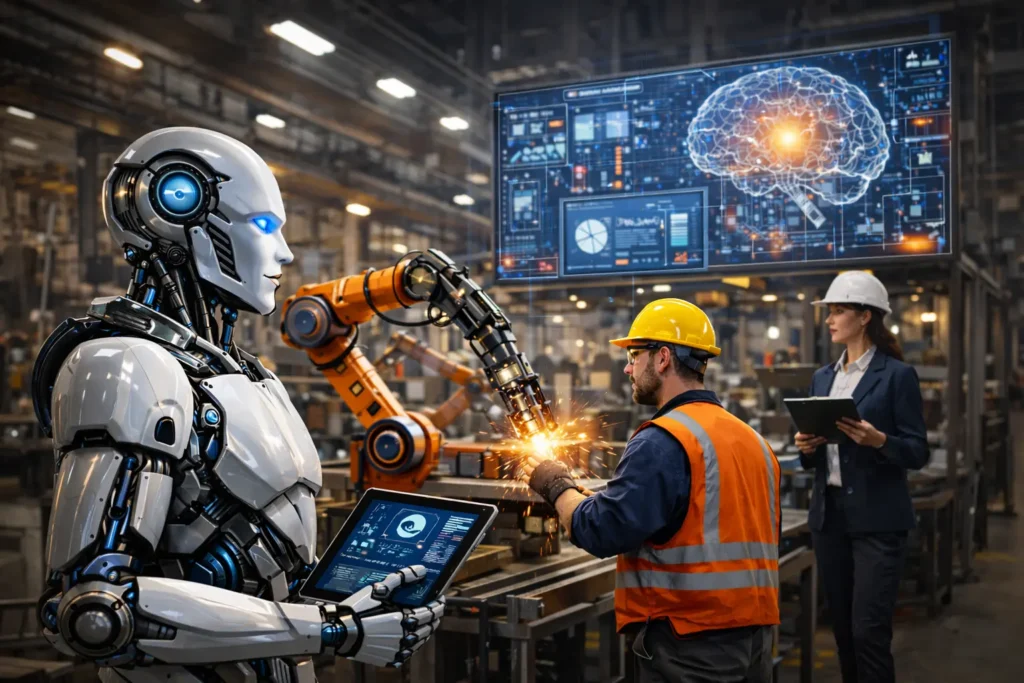
AI in manufacturing is entering a phase where capital and robotics are being developed alongside control systems. This fortnight’s stories show how large investors and robotics companies are changing how physical work is executed. For manufacturing leaders, the focus now is on how quickly these capabilities can be integrated into existing operations.
1. Jeff Bezos Plans $100 Billion Fund to Transform Manufacturing With AI
Jeff Bezos is in discussions to raise up to $100 billion to acquire manufacturing companies and modernise them using AI-driven systems. The plan targets sectors such as aerospace and defence, with the aim of improving efficiency through automation.
What this means for you:
Large pools of capital are targeting traditional manufacturing with the goal of rebuilding operations around AI. This suggests that transformation will be driven by ownership and control of assets rather than incremental upgrades.
Action tip:
Evaluate how exposed your operations are to external disruption. Begin structuring your internal data so AI can be integrated without replacing entire systems. Adopt an easy operating system that is designed to support this transition without requiring large capital investment.
2. South Korea Pushes for Full-Stack “Physical AI” in Industry and Agriculture
South Korea is advancing a national strategy to build physical AI by integrating robotics with software across manufacturing and agriculture. The approach focuses on end-to-end capability within controlled environments.
What this means for you:
Industrial AI is moving toward systems where hardware and software are developed together. This reduces reliance on fragmented tools and improves control over production environments.
Action tip:
Review whether your current automation setup depends on disconnected systems. A more unified data and control layer can improve efficiency over time. Look for operating frameworks that are intended to support this integration without full system replacement.
3. Mark Zuckerberg Building AI Agent to Support CEO Decision-Making
Mark Zuckerberg is developing an AI agent designed to assist with executive decisions, including analysis of internal data and operational planning.
What this means for you:
AI is moving into decision-making processes. Leadership workflows are beginning to rely on systems that analyse data continuously.
Action tip:
Identify decisions that depend on repeated analysis of production or financial data. Introduce AI-assisted tools that can support these decisions with consistent inputs. This can be implemented in stages using structured systems such as the AIFM OS.
4. Mind Robotics Raises $500 Million to Deploy AI-Powered Factory Robots
Mind Robotics has raised $500 million to build robots designed for industrial use, including assembly tasks based on factory data.
What this means for you:
Investment is moving toward robots that operate within real production environments. The focus is on systems that can perform defined tasks with reliability.
Action tip:
Identify manual tasks that are repeated across production cycles. Start capturing structured data from these tasks so that future automation can be implemented with minimal disruption.
5. China Deploys AI Robot Traffic Officers in Real-World Operations
China has deployed AI-powered robotic traffic officers to manage public events, demonstrating use of AI systems in dynamic environments.
What this means for you:
AI systems are now being used outside controlled settings. This shows that reliability in changing conditions is improving.
Action tip:
Evaluate where your operations involve movement or coordination that changes during production. Begin with controlled pilot areas where data is already available.
6. AI-Driven Dairy Startup Automates Farm Operations at Scale
An AI startup, backed by Peter Thiel, has built a system where large numbers of cows move to milking stations through automated signals triggered by a mobile interface. This has eliminated the requirement for active monitoring, training dogs and building too many fences. The company has reached a valuation of $2 billion.
What this means for you:
AI systems can influence behaviour in physical environments through signals and feedback loops. This approach applies beyond industrial settings to agriculture and other allied industries.
Action tip:
Map processes where behaviour can be guided through automated signals rather than manual intervention. These systems can often be introduced without large capital expenditure.
That’s All for This Fortnight
Manufacturing AI is moving toward systems that combine robotics with data-driven control. Organisations that prepare early will define how these systems are used within their operations.
Until next time,
The AI-First Mindset Team
About Us
At AI-First Mindset, we help leaders bridge the gap between knowing AI and using it. Our work includes hands-on workshops, AI integration bootcamps, and operational frameworks designed for manufacturing companies that want to embed AI into workflows without relying on large consulting vendors.Contact us at aifirstmindset.ai.
Recent Newsletters
-
 Published on: March 10, 2026
 -
 Published on: February 24, 2026
 -
 Published on: February 10, 2026